• It was 2:00 in the morning and I was just starting to fall asleep after spending an anxious hour tossing and turning when I heard the noise behind the left side of my head.

    It wasn’t a terribly menacing noise–it was simply a sound like several glass bottles clinking together. It struck me as the sound someone would make if they were rooting around in a glass recycling bin. Not a big deal, except…I was staying in a reportedly haunted house with no glass recyclables anywhere on the premises.

    I was terrified and spent the next two hours trying to talk myself into not being scared.

    I don’t believe in ghosts, but when it’s 2:00 in the morning and I hear an unexplained noise when I’m trying to sleep in an allegedly haunted house, I definitely have big feelings about ghosts.

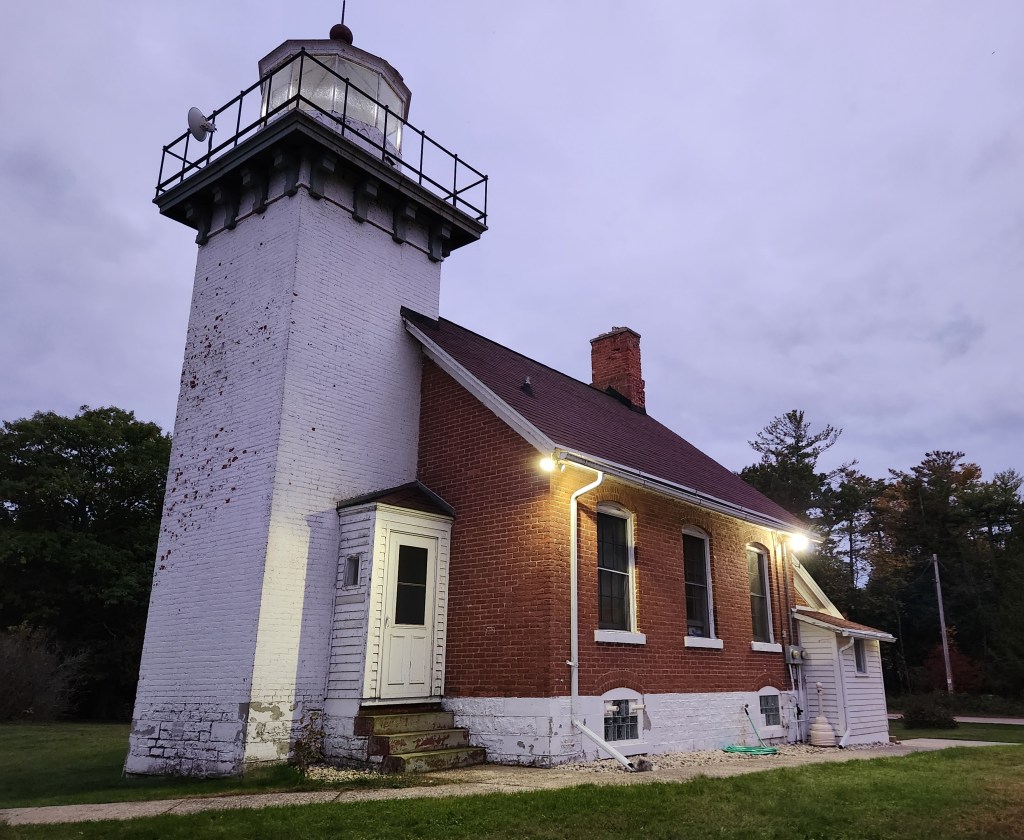
    I assumed the lighthouse where we would be staying would reportedly be haunted (it’s a lighthouse afterall) but I did try to avoid learning about its haunted reputation before our stay. I gave my family instructions: “Don’t tell me anything about how the lighthouse is haunted until after we’ve left.” I studiously avoided mentions of the lighthouse hauntings and ghosts on the internet when I was looking up touristy information.

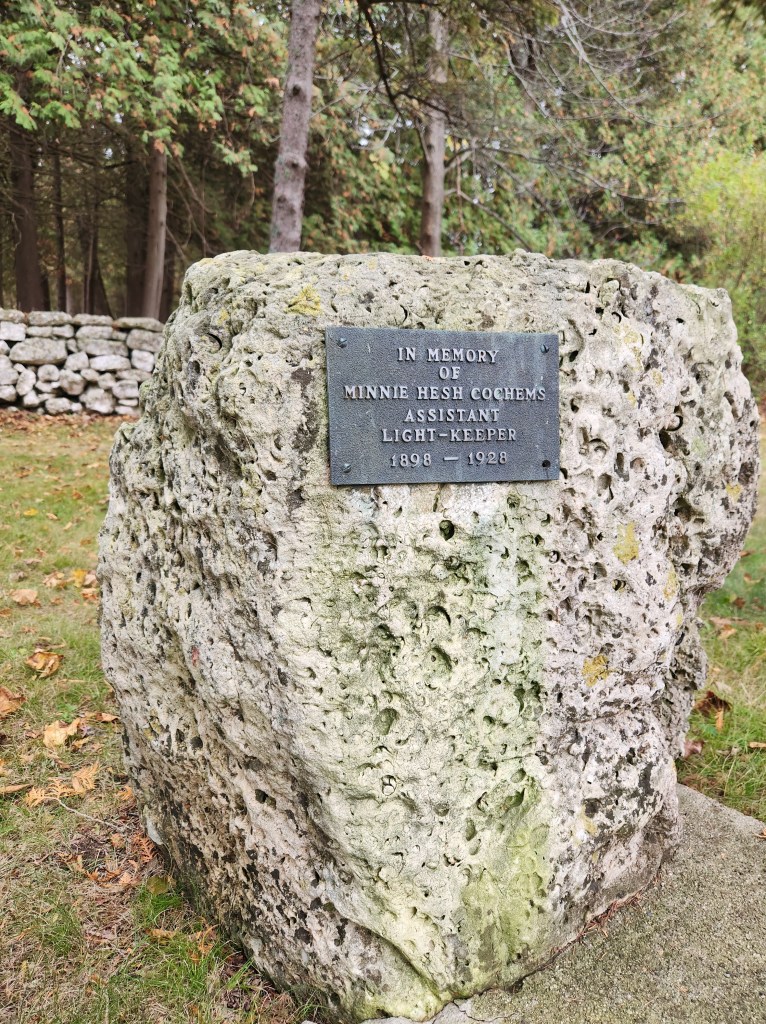
    Once we got to the lighthouse, (Sherwood Point in Door County), I overheard my nephew and his wife reading aloud from the guest diary about the paranormal shenanigans that previous guests recorded. I didn’t hear anything too scary, in fact, the most reported ghost, Minnie, was the assistant lighthouse keeper who died in the house from a stroke (so no foul play, phew!) and she mostly just made noises. She had even been known to clean up after guests. But just the possibility that there was any type of a ghost (even Casper) where I was staying was enough to prime me for some nighttime scaries. (I was already inclined toward them so it didn’t take much).
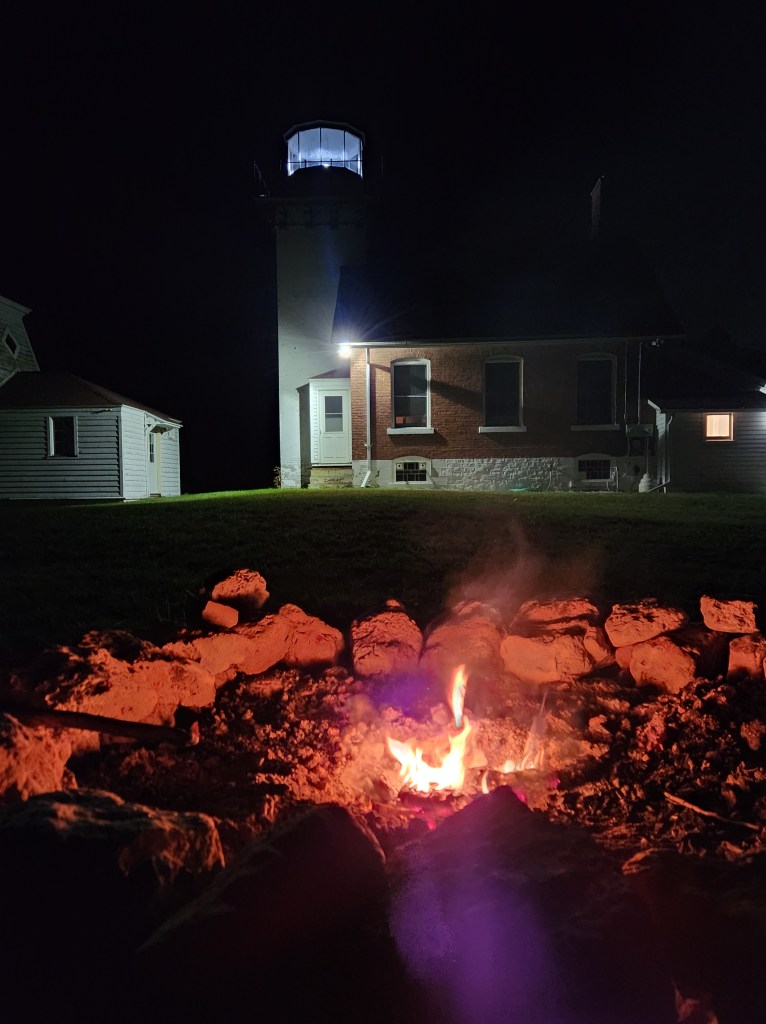
    The first of our three nights in the lighthouse was uneventful, but the second night felt spooky as we sat outside around the fire. I can’t quite remember if anything in particular created a creepy vibe, but I got freaked out when I saw my toddler great niece making jazz hands at the light house light–I thought she was waving at something only she could see. (Eventually I realized she was trying to “turn on” the light, an adorable trick she learned from her grandpa).

    My brother and I were the last ones hanging out at the fire, and when I went inside, my nephew looked a little spooked. Something eerie had happened, but he respected my wishes and didn’t give me details.

    In retrospect, maybe I should have asked to hear the story that night, because when I learned about it the next day, it didn’t seem too menacing. My family had been in the living room, when they heard a loud noise from the kitchen. When my nephew went to the kitchen to investigate, he found a box of graham crackers that had been on top of the refrigerator lying on the floor several feet from the refrigerator. Nothing else was moved or disturbed, and the box had been in the middle of several other boxes. So maybe Minnie just wanted a snack, and who could blame her? (In Buddhism, Taoism and Chinese folk religions “hungry ghosts” have insatiable spiritual and/or emotional hunger–graham crackers might at least help with a literal hunger). I don’t think I’ll ever encounter graham crackers again without thinking about Minnie.

    Whatever Minnie may or may not have been up to,  in the middle of the night, rationality and logic had no sway over me. I. Was. Scared. And I was extra ridiculous because my bed was in a little room without a door, and I just felt like I could NOT lie with my back to the doorway. Even then, I knew that made no sense, because if there was a ghost, why would it be stopped by a door?

    Obviously, I survived the night with no disastrous consequences and only some sleep deprivation. We had a great family vacation and escaped with our bodies, souls, and graham crackers intact. In retrospect, any paranormal experiences we had just make great fodder for the family tales we’ll tell again and again.

    I still don’t believe in ghosts, but my brain and my body and my heart aren’t always (ever?) in agreement, so I’m sure it won’t be long before I’m afraid of something supernatural again (I’m admittedly getting a little spooked just writing this and I hope Chad is home soon). And it does give me pause to have learned since my sleepless, freaked out night when I heard the sound of glass items banging against each other, that one of the reported lighthouse paranormal phenomenon is the sound of glassware tinkling together (okay, this “glassware” seems to be teacups, not bottles, but still…).
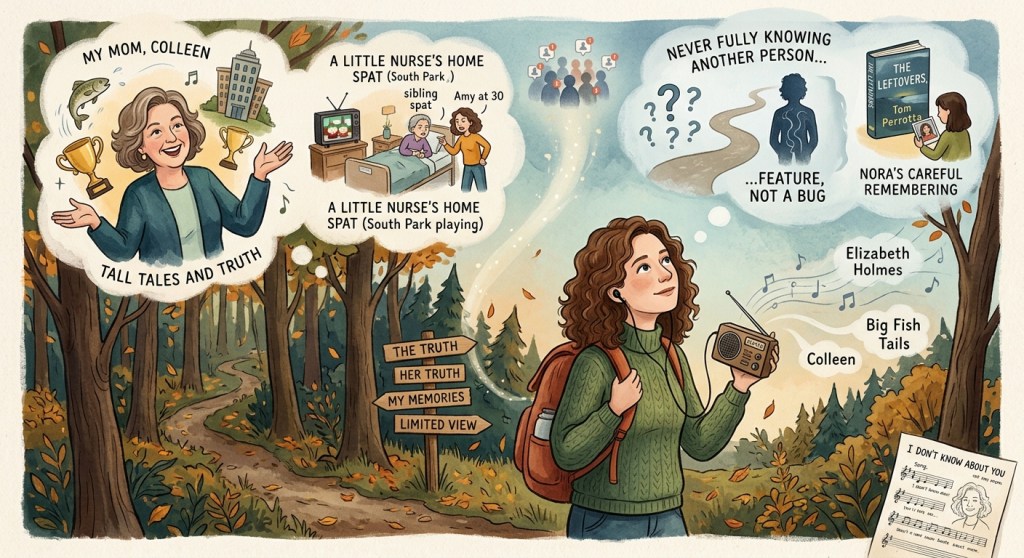

  • My mom doesn’t have much in common with Elizabeth Holmes. Yet I thought about my mom today when I listened to the latest episode of the “Critics at Large” podcast which featured the hosts discussing the new documentary about Elizabeth Holmes. According to the critics on the podcast, the fascinating aspect of the documentary (which I haven’t seen and probably never will) is how it explores the idea of truth and how people lie and how they can believe their own lies.

    My mom wasn’t a fraudulent tech entrepreneur, but like Elizabeth Holmes, she did have an interesting relationship to “the truth”. As I’ve written about before, my mom didn’t deliberately try to deceive others (at least not more than the average person) and she certainly wasn’t a scam artist, but she definitely told “Big Fish” tales and I was never sure how much of her embellishments she actually believed. Perhaps more interestingly (or disconcertingly) my mom’s confident telling of her “truth” always made me question my own version of what I understood reality to be. This wasn’t in any way a form of malicious gaslighting (a term that wasn’t popular during my mom’s lifetime) but simply her way of being Colleen that caused me, and still causes me, to question my way of being Amy. (It also continues to entertain and amuse me).

    I was likely primed to find connections between my media content and my mother today as it is the 26th anniversary of her death. I’ll admit, these anniversaries are emotionally awkward. I feel like it’s probably healthy for me to acknowledge them, but I also don’t see the value of making myself unnecessarily sad. I don’t want to dwell on all the awful memories of her dying and death, but I’m also trying not to repress things. (One grim but somewhat slightly funny memory is that my siblings and I had a little spat in my mom’s room at the nursing home as South Park was playing on the TV. No idea what the argument was about and it didn’t last very long).

    I usually post something on Facebook to commemorate these dead relative anniversaries. I’m not sure how I feel about this weird way of sharing at a distance, of saying “Hey this is kind of a big thing” to potentially hundreds of people without having an emotional interaction with anyone in person. I think Facebook may even be helping me out in this circumstance because I’m not using it to avoid an interpersonal interaction–without Facebook I just wouldn’t let people know that today is the anniversary of my mom’s death.

    I didn’t necessarily plan this as a way to commemorate this anniversary, but I spent some of today doing two of my favorite things in the world–hiking and listening to the aforementioned “Critics at Large” podcast. No direct connection to these activities and my mom, although she would be happy that I was enjoying myself (but she would be very confused about my hiking and probably freaking out that I was doing it alone so I would just have to not tell her about that).

    Feel free to judge but an AI created image that is hilarious in oh so many ways

    I also happened to listen to another thing today that made me think about my mother and what it means to know the “truth” of another person–a passage in the book “The Leftovers” (by Tom Perrotta) when the character Nora muses about remembering her dead (technically missing) family members. Nora describes how she is careful to not look at photos of her dead loved ones too often, not because she doesn’t want to remember them, but because she doesn’t want to get stuck in having only certain memories of them, or remembering them in a way that limits who they actually were.

    I realized a while ago that my knowledge of my mother is limited by seeing her as “my mom”, especially since I was 30 when she died and I didn’t really have a chance to start seeing her as a full person beyond her role as my mom. But am I also limiting my memory of her because I’ve settled on a version of her that is accurate but not complete?

    At a recent funeral at his church, Chad (yes, my husband is a bona fide minister) shared the insight from the Rev. Kate Tucker that we never fully know another person–and that’s a feature, not a bug. Whoa. Valuing the ultimate unknowability of others as a blessing, instead of something that points to our deficiency in connecting or our ultimate aloneness, is a revelation. Or maybe it’s a “yes and” revelation. Yes, in some ways we are so self-absorbed that we never truly know others, even our closest loved ones, because we’re too busy making everyone else the supporting characters in our own story. That’s rather tragic. AND…we can never fully know anyone else, or even ourselves, because people are just so complex and amazing.

    I just realized that a year ago I wrote my first song, “I Don’t Know About You.” Yes, this song was also inspired by my mother and one of her favorite sayings, and here I am again, thinking about my mother and the mysteriousness of people. I don’t think my mom was trying to be too philosophical with her “I don’t know about you” quip and was going for a clear “I don’t know about you because you can be a dumbass” message. (At least I THINK that’s what she meant but I guess I don’t really know…)

    There are so many things we don’t know–about other people and ourselves. Deception and ignorance are generally not desirable or admirable, but not knowing can be full of possibility. It can be frustrating and confusing and lonely not to really know or understand others, but there is always the potential to know at least a little bit more, especially if we are willing to loosen our hold on our ideas of who other people are.

    *Bonus points if this title makes you think of the 80’s Spandau Ballet song

  • Dolly Parton touched and delighted millions of people around the world with her music, humor and generosity.

    Dolly inspired my older sister, Jenn, to create a little parody about feeling left out while in a public restroom. Jenn had her own version of Dolly’s 1978 hit “Two Doors Down” that featured a FOMO wracked narrator lamenting being excluded from a party two STALLS down. 

    Image by DonnaLynn52 from Pixabay

    By simply changing one word, my sister amused my 8 year old self and created an earworm that still infects me today. (Bathroom humor is timeless!) 

    Take that, Weird Al! 

    "Two stalls down, they're laughin' and drinkin' and havin' a party
    Two stalls down, they're not aware that I'm around
    But I here I am cryin' my heart out, feeling sorry
    That they're having a party just two stalls down"

    I also amused (or more accurately, bemused) my sister by changing a word to a song, but my creativity was unintentional. One day my sister overheard teen me singing along to the early 80’s song “Ain’t Nothing Gonna Break My Stride” by Matthew Wilder and asked, rather confused, “What ARE you singing?” 

    The following exchange ensued:

    Me: (confidently) “The lyrics to this song! ‘The road behind was rocky, but not I feel legatay…’ ”

    Jenn: “What is LEGATAY?” 

    Me: “You know, it comes from the word legato, the term that lets you know to play a song smoothly. I think it’s Italian. So it means the person in the song feels cool and relaxed…”

    Jenn: Um, that’s NOT a word. The word in the song is COCKY.

    Me: Oh.

    And scene.

    One of the benefits of being the youngest sibling is I was often entertained by the sophisticated wit of my more worldly sister and brother. Obviously, I was also sometimes the target of that wit in the form of teasing, but I can’t claim that I was too victimized because I participated in my fair share of teasing, too. 

    This is very tame as far as teasing goes, but this nostalgia trip has led me to remember that my sister and brother used to laugh at me because I was often covered in a paste of meat tenderizer, my mother’s folk remedy for mosquito bites (and perhaps rather ironic for someone who would grow up to be a mostly vegetarian?) Okay, “covered” is over dramatic, but my mom did mix up a concoction of Lawry’s meat tenderizer and water to put on my mosquito bites. As I recalled this my first response was to think “What was my mom up to?” but according to Google this meat tenderizer cure actually works! Why did I ever stop doing this–-I’ve always reacted strongly to mosquito bites (or else I’m just a wimp) and they are a bane of my existence. I’m making a vow now to get some Lawry’s asap for the rest of this mosquito season and to be prepared for next year. 

    These little historical anecdotes (or are they vignettes?) aren’t really related and I’m not sure how I got from Dolly Parton to meat tenderizer, (there were several detours as other memories have come back for me, like the time my sister walked in on my friends and I re-enacting scenes from the book “Are You There God, It’s Me, Margaret” in our kitchen–yes, it was as cringey ans it sounds)  but I guess that’s how memory works. The through line is my sister, and as she died in 2023, I’m grateful for the opportunity to bask in these goofy memories of her and our childhood/teendom–even if I’ve got the line “two stalls down” stuck in my head. 

  • I wasn’t expecting to gain insight from Shania Twain. 

    I don’t harbor any ill feelings about Shania Twain–I’ve just never been a big fan or paid that much attention to her. I saw her at the Brandi Carlise music festival in January 2025 and she seemed like a talented musician but not someone I would expect to be dispensing wisdom.

    But recently I listened to an interview with her on the NPR “Wild Card” show and I can’t stop thinking about what I heard her say. (The emphasis here is what “I heard.” I’m not going to try to verify or accurately convey what Shania said as I’m just focusing on my experience and intepretation). 

    The host, Rachel Martin, asked Shania something like “What do you want to do when you’re older? And you can define older as one week from now, or a couple of years, or whatever.” 

    I think Rachel qualified the question because Shania is in her mid-60’s and is already “older” by many definitions. 

    Shania answered (paraphrased by me with artistic license), “I’m going to live to be 200. I’m going to imagine that’s how it’s going to be for me. My imagination has always got me through. I don’t want to feel rushed. I want to take time to do things well and live in the moment.”

    Well, I want those things, too. But don’t I need to feel rushed, at least to some extent, because I am working under a deadline? Like it or not, I only have so much time in this life, and I know more of my life is behind me than in front of me (not trying to factor in any quantum physics such as Block Theory that suggests all time is simultaneous here). Don’t I need some sense of urgency? Don’t I need to recognize the impermanence of life to appreciate it more fully? Don’t I need to reckon with the fleeting nature of the present moment to truly live in the moment?

    What kind of mind-blowing heresy is Shania putting down, and I should pick it up?

    I think Shania helped me realize a paradox: It IS important to recognize how brief and transitory our lives are, but constantly freaking out about that is just going to make me more distracted and less able to live in the now. 

    Sometimes I need a kick in the pants and to embrace “If not now, when?” as a self-help mantra. Other times, “If not today, that’s okay” is the healthier approach. 

    Should I accept I only have so much time or pretend I have all the time in the world?

    Shania’s advice knowingly blurs the lines between imagination and denial. That feels pretty radical. Can we live as if we have enough time for everything we want to do, even when we know we can’t? How does that change how we live? Is it worth being a little delusional for the vibe of possibility the delusion makes space for?

    If I lived as if I was going to live until I was 200, it could make me more complacent. I could take things for granted even more than I already do. Or, I could chill out a bit. I could be more patient with others and myself. And I could be bolder if I thought “Hey, I have time to tackle this or to recover from it if this endeavor goes badly.”

    I’d like to be braver and more relaxed, but I’m not wishing I had more time to achieve any grand goals or accomplishments. I’m basically comfortable with the skill levels I’ve attained. (I’ve let go of the idea that my domestic prowess will ever surpass what I had as a college student. I don’t expect to ever have matching towels.) I mostly just want to keep doing all the goofy inconsequential things I do every day and week and month. Maybe I’ll get slightly better at them (slightly less nervous at open mic) but just to keep doing them would be a blessing. I want to finish all the TV series I’ve got on my personal wish list and eat at all the restaurants I’ve planned to but never quite made it to. 

    Of course I want to keep spending time with my friends and family and pets. Okay, I want to get better at that–have more heart to heart conversations, and silly times, and times where we reminisce and dream. 

    I want more times when we fully embrace that we’re all so heart-breakingly ephemeral and times we pretend that we’re all going to live to 200. 

  • I’m not that excited by telepathy. 

    I realized this a while back (at least several months ago as I’ve not been very prolific with my blogging) when I attempted to listen to the first episode of the extremely popular “The Telepathy Tapes” podcast. This is a very popular podcast that many people are very enthusiastic about (we started to listen to it at the urging of a friend who is an avid fan). As my use of the word “attempted” signifies, I did not become a fan of the podcast. Admittedly, I was, and am, very dubious about the premise of the podcast–that nonverbal autistic children may be telepathic–but my non-fandom isn’t just because of my skepticism. I just found it boring. 

    I am not trying to be a hater to those who are fans of The Telepathy Tapes and/or believe in its theory of telepathy. While I doubt the claims made on the podcast, I’m certainly no expert on telepathy and have only done a cursory bit of internet searching about the podcast (just enough to know that there are scientists who argue against it). 

    What I am claiming to be is someone who found The Telepathy Tapes rather dull. Now I certainly didn’t give it much of a chance–the first episode of any type of show isn’t necessarily that engaging. It often takes a bit to get hooked on a TV show or podcast. But I think my uninterested response to the podcast goes deeper than that. 

    When I think about it, I just don’t find telepathy that intriguing. 

    I DO think telepathy would be very consequential, on both an individual and societal level. I don’t want to have telepathy (unless I could be extremely selective about it and turn it off and on at will) and I certainly don’t want people around me to have telepathic abilities and be able to read my mind. (I don’t think I’m harboring more sinister thoughts than the average person, but I don’t want to advertise my various dysfunctions or subject others to the unfiltered tedious miasma of my mind). I might advocate for telepathy in a superhero type scenario, where a “good guy” could use it to thwart an evildoer. 

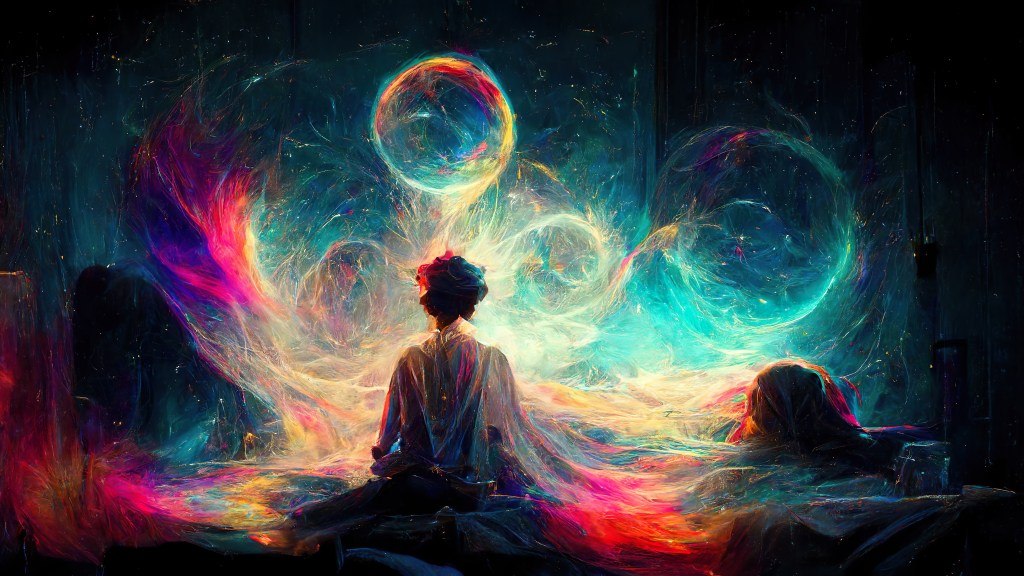
    Does this capture mind-bendingness? Image by Facusio Creations from Pixabay

    I think telepathy would be impactful, but I don’t find it that meaningful. It doesn’t inspire me to reconsider my fundamental thoughts and feelings about the world or my place in it. It’s not a paradigm shifter for me. The idea of it doesn’t give me goosebumps or make me feel like the world is bigger and deeper and somehow more profound. 

    I DO get a thrill of “whoa” when I think about quantum physics and things like  alternate realities, dark matter, quantum entanglement, the Block Universe (the past, present, future exist simultaneously). By no means do I understand these concepts–I’ve only done a small amount of reading  about them (I’ve listened to half of a Neil deGrasse Tyson book) and I’m no quantum physicist (I don’t even play one on TV).  My shallow grasp of these science-inspired concepts probably actually enhances the awe they inspire in me–I’m free to ponder the coolness factor without getting bogged down by equations and what not. 

    I can’t really defend why alternate realities and whatnot are more interesting than telepathy. I can’t honestly come up with any real reasons for how any of the theories I just touted would actually affect my life if they are true. Yes, I could blog about why I find them interesting (and maybe will one day–or already have in another reality) but basically it just all comes down to feels. Quantum entanglement gives me feels; telepathy doesn’t. 

    I’m not that into telepathy, but I am into awe. I want to be more open to experiencing it in big and little ways, and to appreciating when others find it (as long as it doesn’t lead them to doing things that are too goofy).  So this is what I’ve learned from thinking about “The Telepathy Tapes”

    • Embrace whatever gives you awe, makes you feel spinny in the face of the vastness of mystery and wonder. 
    • Just be humble–unless you actually are a rocket scientist or the Dalai Llama, you probably only have a cursory understanding of those mind-blowing concepts, whether they are scientific or theological. You could very well be way off base. 
    • Fall madly in love with ideas–stay up late thinking and talking about them just like you would over a cute crush–but don’t cling. Be willing to give them up and move on if they no longer serve you (and/or you learn they are just flat out wrong). Fall in love again with new ideas. 
    • Accept that awe is a matter of personal taste–whatever floats your metaphysical boat may just be ho-hum for someone else. 

    And if you can ever read my mind–I apologize in advance. Yes, much of the thoughts you will discover will be needlessly bitchy, but mostly they will just be boring and confusing. 

  • I spent every free moment I had on Monday trying to learn to pronounce “Cyclosporiasis.”

    Thankfully, I didn’t need to call the doctor and say I had it. I was hoping to update the lyrics of my song “Salad Days” for an open mic performance tonight. 

    I don’t write topical or current events related songs–at least I don’t intend to. But when you have a song called “Salad Days” that is literally about salad (as a jumping off point for a humorous yet moving song about my complicated and quirky relationships to food and Chad and Chad’s eccentricities about eating), I think you are morally obligated to at least make an attempt to meet the moment. 

    I only intended to make a few small changes to the song lyrics, but it turned out to be surprisingly hard to remember my edits. I just couldn’t keep them in my head. 

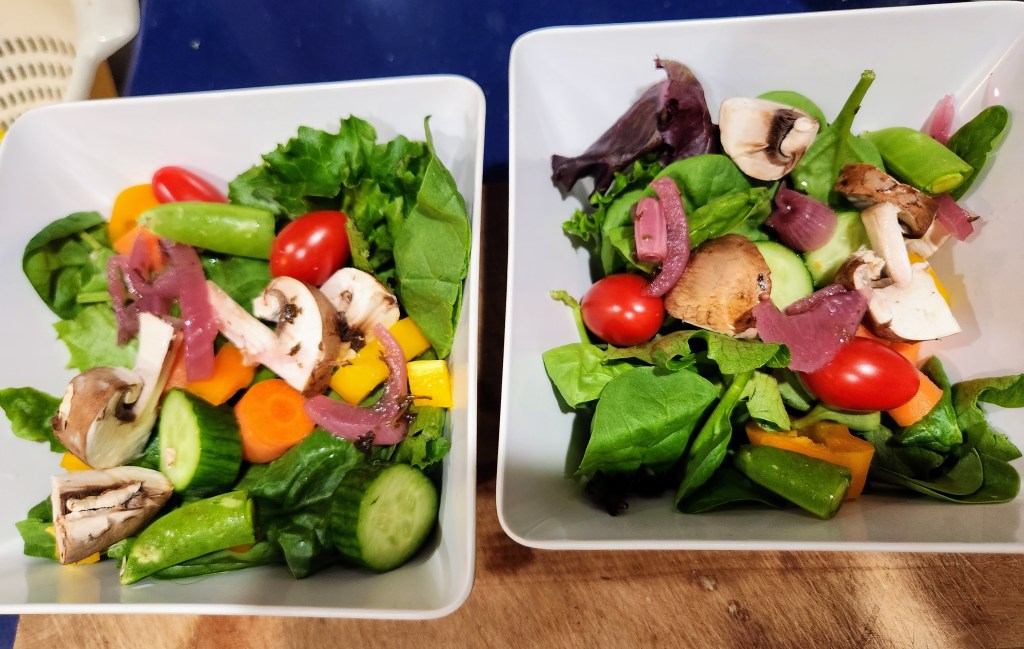
    His and Hers salads

    As I sat in the audience at open mic (at the wonderful Railwerks in Columbia Heights) I kept going back and forth on if I was going to be bold and try my updated version of the song. Yes, it was a wonderful and friendly crowd mostly comprised of regulars who I knew would be supportive and understanding (there were even two bona fide Salad Days “fans” in the audience) even if I failed spectacularly, but it’s never easy to flop. Plus, I was farther down on the sign-up list that I usually am (I like to perform early in the line-up so I can relax and listen the rest of the evening) and as I listened to the other musicians I felt my song slipping away from me. It was no longer merely a matter of not knowing my new lyrics–I couldn’t even remember the chords to Salad Days anymore. 

    Finally the moment arrived: it was time for me to take the stage. Every time I play this is a bit of a production as getting my keyboard onstage and set up is time and labor intensive, even with the help I always graciously get (have I mentioned open mic folks can be the BEST?). I’m always slightly embarrassed it takes so much effort to get me set up just so I can noodle around with a few chords. But I decided to embrace my awkwardness. As long as I was taking up so much metaphorical and somewhat literal space with my keyboard, why not try to sing my ballad of salad with my updated and timely lyrics? I’m not the world’s most accomplished singer, keyboardist, or songwriter, but my original songs are truly original. How could I deny a world in the grips of a salad crisis a song about salad? 

    So I sang my salad song. And I was more or less successful. I only forgot a few chords and my voice only wavered a bit. I really don’t know if I correctly pronounced “cyclosporiasis” but it was close enough. (I think a few people were a little nervous when I introduced my song by practicing my pronunciation of “cyclosporiasis” but I assured them the lyrics weren’t going to be graphic). People in the audience listened, and they smiled and laughed. And I felt mighty because I did something I was scared to do. 

    Hmmm, two things I love to do–perform and eat salad–can be scary, but I plan to keep on doing them for the foreseeable future (though not at the same time). I’m not sure if I’ll do my Cyclosporiasis version of “Salad Days” again, even though it unfortunately looks like it’s going to be timely for a while. 

    And now…my lyrics to “Salad Days” with the new lyrics at the end in bold.


    Salad Days*

    Our salad days are every day
    If you take it literally
    I eat fresh veggies all day long
    and hope you’ll share them with me
    You don’t object to a plant-based diet
    You’re down with brussel sprouts
    But you resent the time and effort
    Sometimes you want to shout

    I’m too tired for a salad
    I think that’s valid
    I’m frustrated by defeat
    Because I have to eat

    Your days are filled with meetings and work
    You’re worried, hassled and stressed
    Having to stop to eat some food
    Puts your patience to the test
    Your family has misophonia
    It can drive you nuts when I munch
    I eat in another room
    So you don’t have to hear the crunch

    You’re too wired for my salad
    I guess that’s valid
    Does it feel like defeat?
    If you hear me eat

    Carrots, broccoli**
    Have a high ROI
    Carrots, broccoli
    Have a high ROI

    You’re still hoping for the day
    When you can just take a pill
    Eating should be saved for special times
    Only something you do at will
    But I want to chew as much as I can
    No smoothies for me
    Booze is the only reason for me to
    Drink my calories

    Please give me a salad
    I think that’s valid
    I think a salad is a treat
    It lets me eat and eat and eat

    But now salad is a menace
    Cyclosporiasis is out to get us

    Now I’m scared of my salad
    I think that’s valid
    It’s a vegetarian defeat
    I might have to eat some meat


    *The phrase “Salad Days” is from Shakespeare but I didn’t know that when I wrote the song. I just had the phrase floating around in the back of my head.

    **I mispronounce broccoli as broc-oh-lie so it rhymes with ROI, inspired by an in-joke from the play “Calendar Girls” that I was in last summer

  • I’m a macrodiaphile.

    It’s not a word that exactly rolls off the tongue, but it’s the invented label created for me by AI (Gemini). Yes, I willingly consulted an AI Overlord and asked: “Is there a word for someone who really really likes long days?” Gemini explained that there isn’t, but that it could make up something for me “by combining some beautiful Greek roots.” So I’m choosing its offering of Macrodiaphile which combines macro (long), dia (day), and phile (lover)—literally, a lover of long days. 

    So yes, that’s me, a macrodiaphile, a lover of long days (days with as many hours of daylight as possible). It’s not that I specifically love sunshine (I usually do) or basking in the sun (although I certainly can enjoy that) but I just want several hours of daylight. Circadian rhythms be damned, I’d love it if the sun didn’t set until at least midnight all year round. 

    At least I think I’d love that. The closest experience I’ve had to living with days that long is years ago when we had a vacation in Anchorage in June and the sunset was never before 11:30. I thought that was glorious, but we were only there for less than a week. So maybe I would eventually get tired of tons of daylight, especially since I can’t sleep if I’m in a room with even a teeny amount of light–but that’s what eye masks are for. I’m willing to take the risk and find out. 

    And yes, I do acknowledge that I wouldn’t be spending most of my life actively enjoying the abundant hours of daylight. I’m very thankful of our Minnesotan mid-summers when it is still light out until 9:30ish, but sometimes I struggle to have the energy to do anything other than watch TV after 9:00 (and being in our basement away from windows seems wrong). And of course I’m not even considering regularly appreciating  hours of sunlight that occur before 7:00 a.m. (can we move those pre-7:00 a.m. hours of daylight to post 9:00 p.m.?). 

    Why do I love the daylight so much? The best answer that I can come up with is that it just feels magical and special. It fills me with awe. All this daylight makes life feel removed from the normal bonds of time. I don’t necessarily have Seasonal Affective Disorder, but the early winter sunsets feel constrictive and claustrophobic, while a 9:00 p.m. sunset feels expansive and vast.

    I’ve also had this recurring dream (or maybe I just had it once but for whatever reason I still remember it) where I’m at my childhood home and it’s well past midnight but it’s still daylight out. Okay, not an exciting dream plot-wise when I describe it, but it had a strong emotional resonance for me and I still think about the feeling of the dream that I can’t capture with words. Beyond the emotional and sensory impact, I don’t think the dream really signifies anything except perhaps I’m channeling the memory of one of my Norwegian ancestors that did live in the Land of the Midnight Sun. 

    Despite my dream setting of the home of my youth, I don’t think I’ve always been a macrodiaphile. As a kid I wasn’t that in tune with the natural world (even though we lived in the country) so while I definitely did not like it when it got dark at 5:00 at night in the winter, I wasn’t exactly twirling around in a field at 9:30 p.m. to savor the lingering light.

    But I am desperately trying to savor the long days now, and honestly, I feel some pressure about it. How can I possibly make the most of this fleeting time of grandeur? How can I ever soak up enough light to sustain me through the confines of winter? 

    This time near the summer solstice fills me with wonder of what is and dread what’s coming. 

    Maybe that’s part of the reason I care so much more about the long days in my late middle age. I now have a much better understanding of how fast time goes, and that these long days will be gone in what feels like an instant. And I now also understand more fully that even if I’m super optimistic about time, I only have so many light-filled summers ahead of me (not trying to be morbid or dramatic but sometimes the math is just staring one in the face). 

    I know that to fully experience life and soak it up, I need to live in the present, to be mindful of what is happening NOW, and not obsessing about the future. But it’s so hard for me to enjoy something knowing that it isn’t going to last. Of course, nothing in life lasts–I’m not exactly forging into new philosophical or spiritual territory with this blog post. But impermanency feels particularly real and poignant to me when I ponder the small window of time I have to enjoy summer’s long days.

    Being aware of impermanence isn’t all bad–it does make me appreciate life’s delights, like long days, more.

    I started this post with an AI made-up Greek based word, and I’ll end with a real, if not quite right, German word (also supplied by AI): “Abschiedsschmerz”. Literally this means “farewell-pain”, so I’ll tweak it to mean “anticipating a farewell-pain” (I’ve got a significant amount of German ancestry mixed in with the Norwegian so I think I’m allowed.) Trying to learn how to pronounce this word can distract me from my macrodiaphile-related angst.

  • I attempted to participate in a cultural phenomenon today. 

    I failed.

    My goal was to see the “Beyond Walls” art project at Boom Island Park in Minneapolis, a 12,500-square-foot land art mural by Franco-Swiss artist Saype. Posts about the mural kept popping up on Facebook and Instagram, and my co-workers were talking about it, and Boom Island is rather close to our house, so it seemed like a good outing for a gorgeous Friday afternoon when I was looking for a little adventure without traveling too far.

    So I put on sensible shoes and a baseball cap, grabbed a water bottle, and headed out. I parked at another little park about a mile and a half from Boom Island, because I wanted to get some walking in. Of course I wasn’t completely confident that I would actually find Boom Island Park, even though I’ve been by it a thousand times and even in it at least once, because I know myself. But before too long I actually made it to the park. 

    Success! So I started walking…and walking..and walking. 

    No mural. 

    I backtracked. I walked into the park again, this time on the other side of the field where I thought the mural would be. 

    No mural. 

    Doubt crept in. Was I actually in the right park? Was there another part of the park where the mural would be?

    Eventually I got brave and asked another park goer who was walking a very nice dog if she knew where the mural was. She did indeed–or at least she knew where it HAD been. Recent rain had washed it away. 

    Well damn. 

    Yes, I knew the mural was intentionally temporary, but I thought as it had only been created a week ago, and everything I read said it should last three weeks to a couple of months, it would still be there. I guess SHOULD was the operative word, and I should have realized that we’ve had a lot of rain since it was created. 

    Actually, I wasn’t that disappointed or annoyed. I was enjoying a beautiful day outside and the mural inspired me to visit a park that I normally wouldn’t make time to visit. My walk also took me through the relatively new Graco Park which I’ve never checked out (I used to run through that area when I did “long runs” which I haven’t done for a couple of years and I have some feels about that. I’ll note that it was a good emotional/psychological step for me to revisit a place I used to run and now “just” walk and to confront and somewhat accept that change).

     It would have been much more frustrating if the mural had been there and I had somehow just not been able to find it (a very real possibility for me). I appreciated the clarity of knowing that I hadn’t just been unable to find it. My only note is that Minneapolis should update its website to say the mural has washed away. Social media content creators also need to get on it and inform folks.  

    So my little expedition wasn’t a failure afterall–just an experience that was not what I originally planed on. And it’s beyond corny to say this, but being able to see that and being slightly flexible with my expectations is beyond a win (even if a small one) for me. 

  • I’m overinvested in a story about people who wanted to be pirates. (Not actual pirates, but Disney “Pirates of the Caribbean” type pirates). 

    I don’t know these aspiring pirates personally–I learned about them when I recently watched a 2012* episode of “Bar Rescue.” I don’t usually play in the reality TV show viewing space, but I watched this with my niece during a family visit. 

    I don’t want to get bogged down into reviewing “Bar Rescue” or focusing on the actual folks in this episode and what happened to them during and after the show–I’m sure if you’re interested you can find anything you want to know on the internet. (I’ve definitely spent some time doing just that and will likely spend even more.)

    Setting aside all the “plot” and “character” questions this episode raises, I think I got a bit obsessed with it because it made me wrestle with the idea of following a dream. The heart of the pirate bar story seems to be “Should you follow your dream or choose financial success and stability?”

    Shamelessly using an AI generated illustration with cute kittens. The prompts I used to get this from Gemini: “please create a cute and funny illustration of kitten pirates at a bar…please make it less of a comic illustration and less cute….please create a photo like cute pirate kittens at a bar, with no injured kittens.”

    Like many people, I’m a sucker for a “follow your dream” story. And my first response to those tales is an enthusiastic, “Hell YES! Follow your dream!” There are a bazillion dream pursuit stories, and for me, none are more mythic than my beloved Muppets. Kermit, Fozzie, Miss Piggy and the gang–they are all about following their dreams despite setbacks and people telling them they can’t succeed, and making good friends and heartwarming mayhem along the way. A devoted Muppet fan like myself HAS to support dream following, right?

    I also just recently listened to “Actress of a Certain Age” by Jeff Hiller, a delightful and inspiring memoir about an actor who finally realizes his dream of having a substantial role in a big network TV show (HBO’s AMAZING “Somebody Somewhere”) in his late forties (an age which now seems relatively young to me). Hiller advocates the “dreams don’t have deadlines” philosophy so I feel renewed inspiration to be on Team Follow Your Dream.

    But…the Bar Pirates. One thing that seemed clear from their tale as portrayed on “Bar Rescue” is they couldn’t live their dream in an economically tenable way. Am I soulless to think that they had to give up their dream and find a way to support themselves financially? Afterall, my response when I saw “Rent” all those years ago was, “I don’t feel that bad for these young starving artists, they really should all just get a job and pay their rent.” 

    I guess the real question isn’t “Do I think the Bar Pirates should have given up their dream?” but “Have I given up on my dream(s)?” I don’t think so–I don’t remember any burning desire to do something that I haven’t. But maybe that just means the REAL real question for me is: “Have I ever had any dreams?” 

    Is the only reason I’ve never given up on a dream because I haven’t had any?

    Yikes, that feels bleak. So it feels like it’s important to back up for a moment and define what I mean by a “dream.” I’ve had hopes, aspirations, and goals, but I don’t think I’ve ever felt like “I MUST do THIS!” in a big picture, “this is my life’s calling or mission” sense. 

    In many ways I am not a flexible or adaptive person. I don’t generally go with the flow. But I think I’m flexible about my dreams. Performing is a good example of this–if you know me at all, you know I crave the spotlight. My interpretation of “spotlight” is pretty loose, though. I’ll act, sing, drum, read one of blog posts or a children’s story–basically whatever opportunity I get, I’ll take, but I don’t have my heart set on a certain path. I’m even a little uncomfortable with the very common question, “What’s your dream role?” That question makes me twitchy because I feel locked in…what if I don’t ever get that role? What about all the other roles that I don’t even know are possible that might be out there for me? So I definitely have a desire to do something rather specific–perform–but I try to be open to what that might look like. 

    And what does it really mean to embrace the idea that dreams don’t have deadlines? I think that only works if we’re flexible and willing to adjust what fulfilling a dream looks like, especially if a dream depends on our physical skill and abilities. Unless we are non-aging muppets (and even muppets are in some ways affected by the passage of time and societal and cultural changes) how we are able to do things can be pretty different at 25 vs. 75. 

    A narrative of “Dream vs. Despair” makes for compelling entertainment, but it can be a false dichotomy. Just because I’m not a Broadway star doesn’t mean I have to be miserable. If a dream is thwarted, or worse, never even dreamed, because of racism, sexism, classism, ableism, or any other type of oppression, then that is an injustice we should all fight against. But sometimes our dreams just aren’t a good fit for us, or aren’t a good fit for us anymore, so we can reimagine them. 

    Back to those Bar Rescue Pirates: Did they set themselves up for disappointment and failure by narrowly defining their dream and the options available to them? I’m not an expert on pirating or bar ownership, but maybe they could have had a moderately successful restaurant that wasn’t pirate-themed (without the awful corporate theme the Bar Rescue host tried to force on them) and performed as pirates at a local renaissance fair? Or regularly held a pirate role playing game where they drank fruity drinks? These are just a couple of ideas I’m throwing out there, but I think they needed to consider what it was they loved about dressing as pirates and having a bar to try and figure out if they could meet those needs in other ways. 

    Maybe I’m just vague and not overly ambitious when it comes to dreams. There are experiences and feelings I desire to have, but I’m open to how I’ll get there. I want to be loved, and happy, and not create too much havoc. Hopefully I’ll get a little praise and affirmation (and a few blog readers) along the way. 

    *https://www.imdb.com/title/tt2264672/

  • I lied in church. In front of the whole congregation. 

    I arrived at church late (as I usually do) but not too late, just a few minutes after our start time. As I entered the sanctuary and walked up the aisle to select a seat that wasn’t conspicuously in the very back but not too far up front, the service leader spotted me and asked me a question from the pulpit. A question that caused me to panic and lie. 

    Did she call me to account for a sin I had committed (which in our church is most likely to be a sin of omission like not recycling or not donating to public radio)? Did she ask me why I hadn’t signed up to volunteer with the local food shelf or help out with our upcoming service auction?

    No, she merely asked me if I would come up and light our chalice. Our chalice lighting is a lovely little ritual that we use to open every service, and I’m sure she thought it was a benign request that I could easily fulfill. But the thought of lighting the chalice, especially when being asked on the spot, filled me with anxiety. 

    So I lied and said, “No, I don’t like fire.”

    It’s not a lie that I didn’t want to light the chalice, but it is a lie that I don’t like fire. I do like fire, but I don’t like to make or light fires, even when all that is required is using a simple lighter wand. The full truth is that I don’t like to use tools of any kind, or anything that requires even the teeny tiniest amount of technical skill or dexterity, especially in front of other people. 

    I have many theories about why I struggle with simple tasks that require any tool wielding or manipulation of the physical world. Primarily, I have limited body awareness–I don’t fully experience or understand how my body operates in the world so I don’t really get how it can manipulate my environment. I’ve lived a lot of my world oblivious to my surroundings because I’m wrapped up in my own head (my dreamy/self-involved Picses nature at play?) Plus, I don’t like figuring out puzzles or following directions or thinking sequentially through a process–everything that seems to be involved in a task like using a vacuum cleaner attachment. Perhaps most importantly, I have very little patience with “things” and get frustrated easily, so if I have to do more than press one button, I’m likely to give up. 

    I could have just said “No” and left if at that, but an answer that concise felt rude and weird. I thought I needed an explanation, but going into a long  (or even medium length) explanation about how I’m embarrassed to use tools in front of others seemed even more awkward (and our services always run long so I did not want to hold up the show). So I went with the shortest explanation that I could come up with in the moment: “I don’t like fire.” 

    The service leader was unfazed by this and quickly found someone else to light the chalice. The service moved on. I’m sure most people barely registered that this little exchange had happened.

    If I do try to light a fire we need to be prepared

    But of course I spent the next 5 minutes (or was it 5 hours?) obsessing about what everyone was thinking about me and my stupid response. Would I be peppered with questions after the service about why I was scared of fire? (I was not).

    I WANT to be someone who doesn’t worry too much about what others think of me (as long as it’s not because I’ve honestly caused them some harm). Yes, I am a people-pleaser who actively (sometimes pathologically) seeks affirmation, but still I like to think I’m someone who doesn’t get embarrassed because I do unusual or silly or dumb things. I embrace my nonconformity: “Hey, I’m me and I’m proud I’m unique and quirky.” I’m not bound by conventional bourgeois social norms. I’m not trying to impress anyone with my achievements or my jet-setting lifestyle. 

    “We all love ourselves more than other people, but care more about their opinion than our own.”–Marcus Aurelius

    But I’m not actually a person who easily goes through life not worrying about the impression I make or if I’m living up to expectations. Maybe I wouldn’t have worried about people thinking I was a weirdo for not liking fire if it was true. Or maybe I wouldn’t have worried, or at least not as much, if I hadn’t been surprised by the request and had a chance to tell the whole truth that I don’t like making fire (Chad just read this and said I am actually not allowed to make fire, even a tiny fire to light a candle, because I can’t be trusted. I can’t really argue with him). 

    And of course, I wouldn’t have felt I needed to lie about not liking fire if I wasn’t embarrassed to try and operate tools in front of others. 

    My life lesson from this little incident is to accept that I worry about what other people think of me, just like most humans do, and I’ll try to remember this and be less judgmental when I see others worrying about the impression they are making. We may be overly self-conscious and silly, but well, that’s how most of us make our way through our social world.

    Or maybe I just need to learn how to lie better on the spot and come up with interesting excuses more quickly.